By: Staff Reporter | www.thepointafricanews.com | New York
New York, USA – A press release issued by Liberia’s Ministry of Information, Cultural Affairs and Tourism (MICAT) says the African Three (A3)—comprising Liberia, the Democratic Republic of the Congo, and Somalia—used a recent United Nations Security Council meeting to outline policy positions on the role of United Nations Police (UNPOL) in peacekeeping missions.
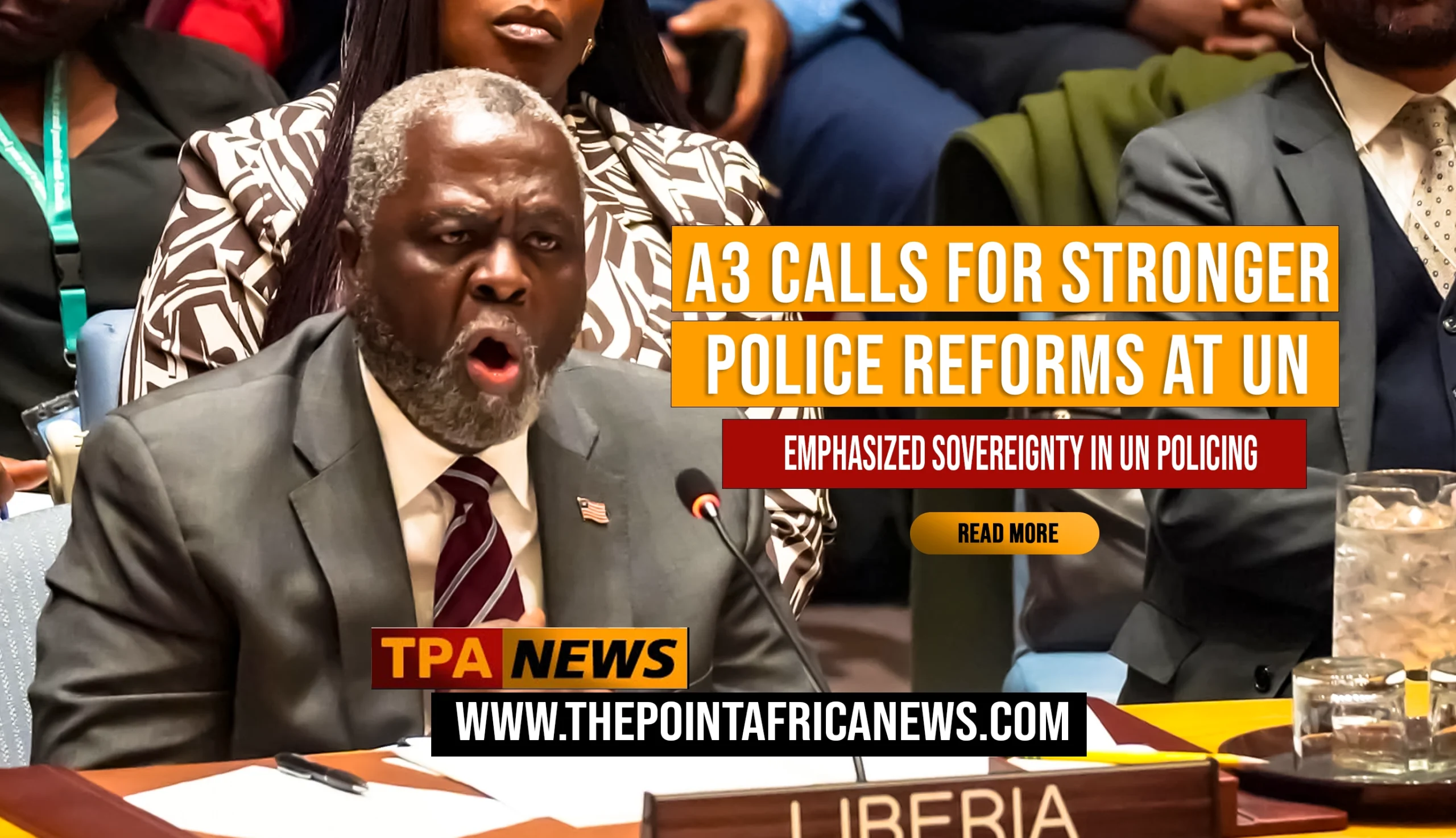
The statement was delivered by Liberia’s Permanent Representative to the United Nations, Ambassador Lewis Garsedeeh Brown II, during a Security Council session convened to review UN policing in peace operations.
MICAT said Ambassador Brown spoke on behalf of the A3 and acknowledged briefings by Under-Secretary-General for Peace Operations Jean-Pierre Lacroix, as well as senior UN Police officials serving in South Sudan and the Democratic Republic of the Congo.
The Ministry of Information, Cultural Affairs and Tourism of Liberia is quoted as saying that the A3 paid tribute to UN peacekeepers who have lost their lives in the line of duty, noting that more than 4,300 UN personnel—including police officers, military personnel, and civilians—have died in peace operations since 1948.
The release from the Liberia’s Information Ministry asserted that the A3 emphasized that these losses highlight the importance of peacekeeping approaches that are effective, sustainable, and responsive to local conditions and highlighted Africa’s position as both the largest host of UN peacekeeping missions and a major contributor of police personnel, arguing that this dual role provides African states with practical insight into peacekeeping challenges.
The group reportedly maintained that UN policing efforts are most effective when they focus on strengthening national institutions rather than replacing them and that assistance to host-country police services should be requested rather than imposed, implemented through partnership rather than parallel structures, and designed to ensure long-term capacity transfer.
The release further states that Ambassador Brown referenced Liberia’s experience during the United Nations Mission in Liberia (UNMIL) as an example of nationally led police reform supported by international partners, while cautioning that peace efforts lacking national ownership may not be durable. They argued that police capacity-building should extend beyond classroom training to include joint patrols, investigations, leadership mentoring, and reforms aligned with national strategies.
The African Three (A3) said such approaches are intended to build resilient police institutions capable of operating independently after peacekeeping missions end. The group also raised concerns about gaps between Security Council mandates and the resources allocated to implement them, warning that such discrepancies could expose civilians and peacekeepers to increased risk and result in mandates that do not adequately reflect host-country priorities or operational realities.
On modernization, the A3 acknowledged the role of technology in contemporary policing but cautioned against creating new forms of dependency, stressing that technological tools introduced by UN Police should be sustainable and locally maintainable. The group further reiterated support for increased deployment and leadership of women in policing roles, describing their participation as operationally important for community engagement and trust-building in conflict-affected environments.
MICAT said the A3 also underscored the importance of strengthening cooperation between the African Union and the United Nations, noting that African peace and security mechanisms are grounded in regional legitimacy and experience. The group concluded by stating that the success of UN police missions should be assessed by the capacity, legitimacy, and public trust of national police services after peacekeeping missions draw down.