

By: TPA News Desk | [email protected] | OPINION EDITORIAL
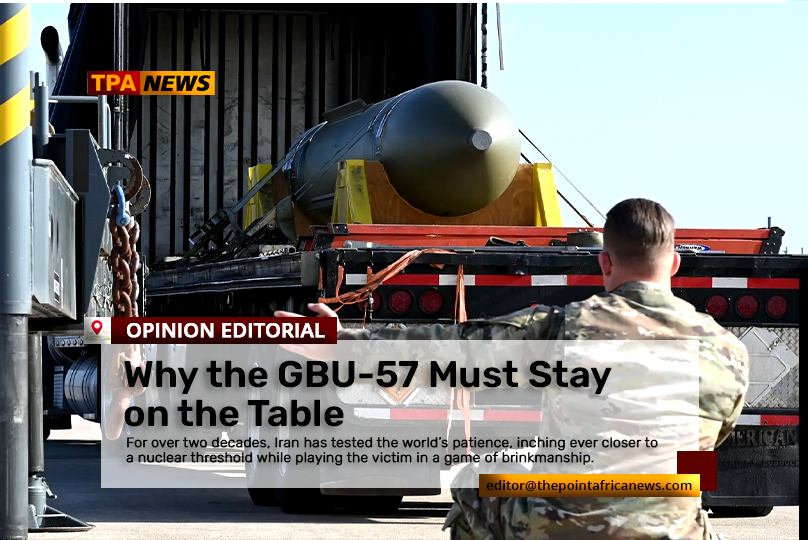
For over two decades, Iran has tested the world’s patience, inching ever closer to a nuclear threshold while playing the victim in a game of brinkmanship. Its enrichment facilities are deep underground, beyond the reach of ordinary bombs. That’s not a coincidence—it’s a shield of arrogance. A signal that Tehran believes it can hide its ambitions from accountability.
But technology has finally caught up. Enter the GBU-57—a precision-engineered, bunker-busting marvel capable of penetrating the Earth to reach what Iran has buried. It is the one weapon that shatters Iran’s illusion of invulnerability.
Critics argue that using such a weapon would escalate tensions. But what they overlook is that not using it—while letting Iran continue unchecked—leads to a far graver outcome: a nuclear-armed theocracy emboldened by impunity.
Israel cannot do this alone. It lacks the aircraft capacity to carry the MOP. The United States must maintain credible deterrence—not to ignite war, but to prevent one. The message is simple: no matter how deep you hide, there is nowhere beyond accountability.
The use of the GBU-57 doesn’t need to be imminent, but its visibility is essential. It is the very presence of overwhelming force that gives diplomacy a spine. History has shown that adversaries only come to the table when they believe there’s a cost for not doing so.
This isn’t about bloodlust. It’s about boundaries. Iran has crossed many, and unless the world sets one that can’t be ignored, the price of inaction will be far higher than the cost of deterrence.