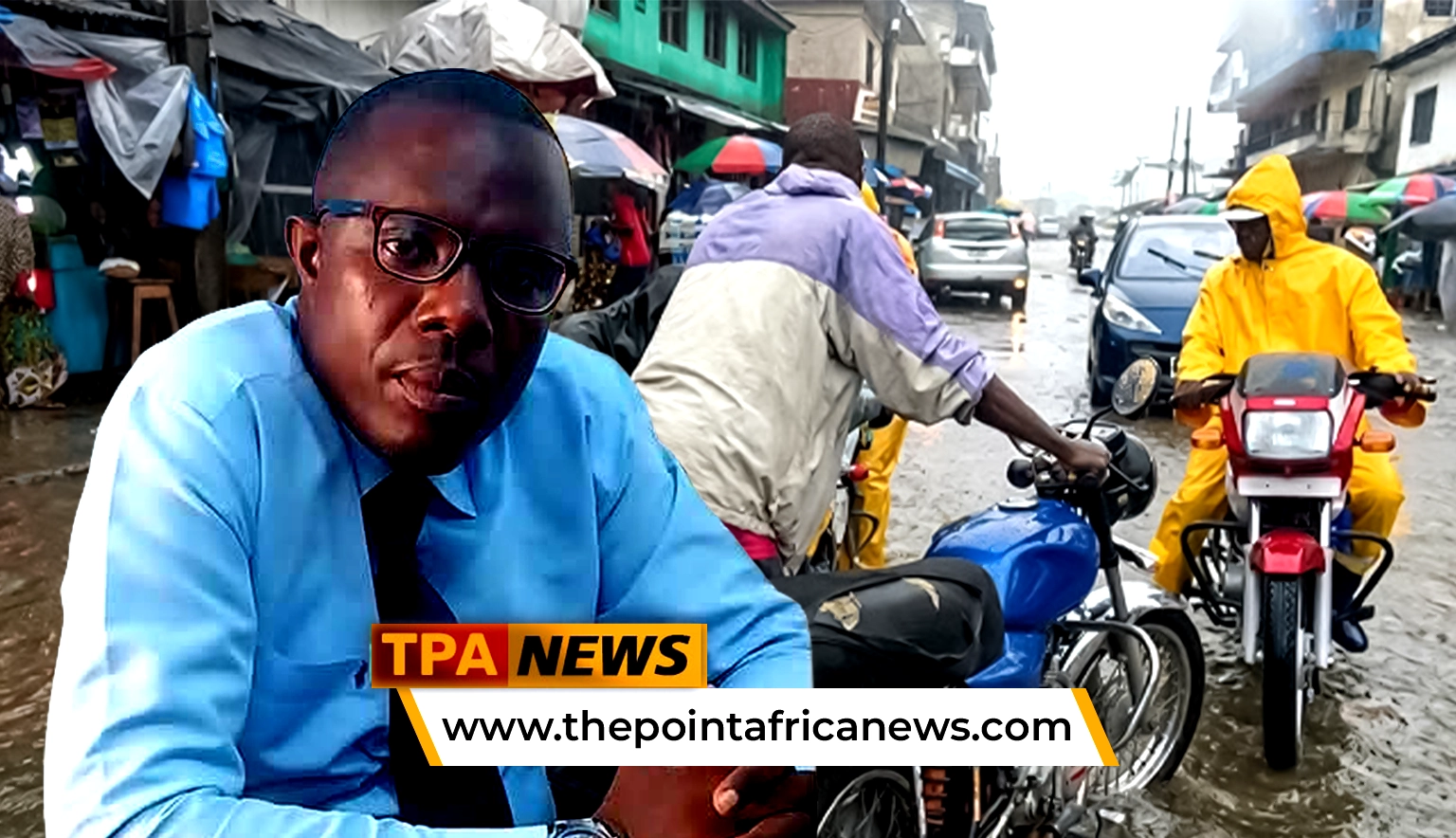
Every year, when the rains come, families living in Liberia quietly worried their hearts out. Why? Because, rooftops peel away in the night. Rivers that children play near in the dry season become walls of brown water by morning. Families wake to find everything they own floating. And every year, the warning comes — too late for some, too familiar for others.
This year, the National Disaster Management Agency is sounding that alarm early. Speaking in Monrovia on Friday, NDMA Public Relations Officer Archievego Menneah Doe said projections based on weather forecast data indicate that no fewer than 100,000 Liberians could be affected by climate-related hazards before this rainy season is over. The threats he cited were the familiar trinity — rainstorms, coastal erosion, and flooding — with forecasts pointing to up to 15 inches of rainfall, and August and September expected to be the most devastating months.
“It is anticipated that not less than 100,000 persons will be affected by climate-related hazards,” Doe said. Strong winds, blown-off roofs, and extensive flooding of homes are among the consequences the agency is bracing for.
The number is alarming. It is also not new.
In June 2024, unprecedented floods killed two people and displaced nearly 50,000 Liberians — with torrential rains on a single day displacing 8,000 people and severely damaging homes, schools, and hospitals across Montserrado, Margibi, and Grand Bassa counties. At that time, NDMA said an estimated 100,000 people were at risk and called for USD 10 million in international support to manage the crisis.
In 2025, NDMA’s Executive Director Ansu V.S. Dulleh projected more than 60,000 Liberians could be affected, warning that Monrovia alone could receive over 800mm of rainfall in July and August. Now the projection has climbed back to 100,000 — and the structural conditions that produce these numbers have not changed.
According to analysts, there are still no effective national early warning systems in place for floods at the national or local level. The country’s disaster risk management policy has been criticized for not putting enough emphasis on flood management — a reflection of the historically low priority given to controlling and managing floods in Liberia.
Even though, the agency had helped develop a National Disaster Risk and Resilient Strategy covering 2020 to 2025, a National Action Plan for Disaster Risk Reduction, and community-based early warning initiatives that have trained volunteers and local leaders across all 15 counties with a climate information project been underway involving NDMA alongside the Liberia Meteorological Service and Liberia Hydrological Service, designed to collect weather data, introduce forecasting models, and scale up evidence-based early warning responses countrywide but between policy and pavement, the gap remains wide.
Civil society voices say Liberia still lacks a robust, community-centered disaster preparedness strategy. Informal settlements continue to expand into wetlands. Zoning laws exist but go unenforced. “We appreciate the government’s response, but enforcement is often weak and reactive,” one civil society leader noted, asking not to be named.
The broader exposure figures tell the story starkly — approximately 2.2 million people in Liberia are exposed to floods, 320,000 to coastal erosion, and 2.1 million to windstorms, according to the United Nations Office for Partnership. These are not projections. They are the baseline. The NDMA has urged citizens to observe safety protocols and report emergencies via its hotline — 2024 — as well as 911 and 4455. The agency is working with UN partners to address the threat. What it cannot do alone is fix the drainage systems that don’t exist, relocate the communities built on floodplains out of necessity, or enforce the spatial planning policies that have gathered dust for years. The rains are coming. For 100,000 Liberians, what happens next will depend on more than a warning.

David S Johnson
David S. Johnson is a seasoned Liberian investigative journalist and multimedia professional who has been active in the media industry since 2016. After serving in various reporting and administrative roles for several prominent local news outlets, he transitioned into media ownership as the founder of The Point Africa News and Media Consultancy Agency Inc. Based in Monrovia, his registered agency provides a comprehensive blend of local, regional, and global news coverage.