Live

Boakai Pushes for Streamlined Public Sector as Port Bills Face Setback

By: TPA News Desk | editor@thepointafricanews.com President Joseph Nyuma Boakai has vetoed two port-related bills recently passed by the National Legislature, citing ambiguity in key provisions and an overextended governance structure. In a communication addressed to Senate President Pro-Tempore Nyonblee Karnga-Lawrence, President Boakai expressed concern that the current language in the bills could create confusion […]

Author

Staff Writer • 5 min read

Sunday, 20 July 2025 20 Jul 2025
Share𝕏f
Boakai Pushes for Streamlined Public Sector as Port Bills Face Setback

By: TPA News Desk | editor@thepointafricanews.com
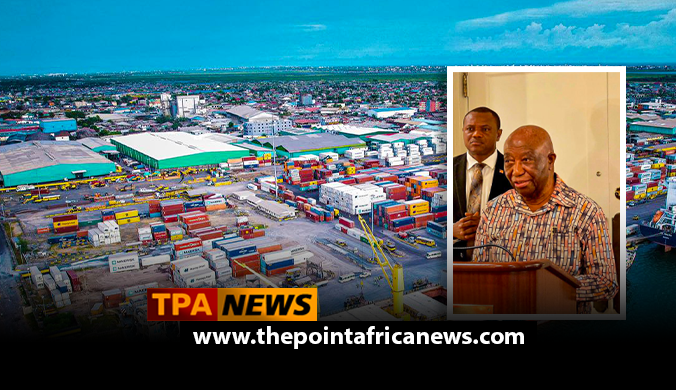
President Joseph Nyuma Boakai has vetoed two port-related bills recently passed by the National Legislature, citing ambiguity in key provisions and an overextended governance structure. In a communication addressed to Senate President Pro-Tempore Nyonblee Karnga-Lawrence, President Boakai expressed concern that the current language in the bills could create confusion and undermine institutional efficiency.

The legislation, which proposed the establishment of nine-member governing boards for each of Liberia’s ports, was deemed by the President as “excessive” and potentially unmanageable. Boakai invoked Article 35 of the Liberian Constitution to return the bills for further legislative scrutiny.

“I hereby veto the two bills and return them to allow the National Legislature to kindly take another look,” President Boakai stated, urging lawmakers to address what he called structural loopholes and ensure clarity in legal frameworks governing national infrastructure.
Advertisement

Reach 2M+ pan-African readers

Advertise with us →

The President emphasized that while he supports reform and development within the port sector, it must be done within a governance structure that promotes transparency, accountability, and efficiency. He reaffirmed his administration’s commitment to responsible public sector management and legislative clarity.

Boakai’s veto comes amid broader calls for institutional reform in Liberia’s state-owned enterprises and highlights growing scrutiny of how legislative decisions align with national development goals.

Author

Written by

Staff writer at The Point Africa News.

Related Stories

78-Hour Legislative Ultimatum: House Intervenes as Monrovia Port Gridlock Strangles Liberian Supply Chains
Business

78-Hour Legislative Ultimatum: House Intervenes as Monrovia Port Gridlock Strangles Liberian Supply Chains

MONROVIA, Liberia — The House of Representatives has stepped directly into Liberia’s maritime logistics crisis, constituting a Joint Committee on Good Governance and Maritime Affairs and imposing a strict 78-hour deadline to dismantle severe cargo congestion at the Freeport of Monrovia.

David S. Johnson•21h ago

Ghana Champions Inclusion of Caribbean Nations in AfCFTA Architecture
Business

Ghana Champions Inclusion of Caribbean Nations in AfCFTA Architecture

ACCRA, Ghana — In a move aimed at translating historical transcontinental ties into formal commercial structures, Ghana has formally proposed extending the trade and investment framework of the African Continental Free Trade Area (AfCFTA) to include the Caribbean Community (CARICOM).

David S. Johnson•23h ago

Morocco Halts African Tomato Shipments as Domestic Inflation Mounts
Business

Morocco Halts African Tomato Shipments as Domestic Inflation Mounts

RABAT, Morocco — The Moroccan government has temporarily suspended export permits for fresh tomatoes bound for sub-Saharan African markets, prioritizing domestic supply stabilization as retail prices approach record highs of 12 to 15 dirhams ($1.20–$1.50) per kilogram in local markets.

David S. Johnson•23h ago

OECD Warns Africa’s Shallow Corporate Debt Markets Constrain Private Sector Expansion
Business

OECD Warns Africa’s Shallow Corporate Debt Markets Constrain Private Sector Expansion

PARIS, France — Africa’s corporate debt markets remain structurally undersized and ill-equipped to supply the long-term capital required for continental economic growth, according to the OECD’s Africa Capital Markets Report 2026 released on Friday. Outstanding market-based corporate debt across all 54 African economies reached just $211 billion at the end of 2025—representing a mere 0.3 percent of global corporate debt despite the continent accounting for nearly 2.7 percent of global GDP.

David S. Johnson•23h ago

Enjoying our journalism?

Get the biggest African stories in your inbox every morning.

By subscribing you agree to our privacy policy. Unsubscribe anytime.