Live

Kenya Bolsters Financial Crime Fight as President Ruto Signs New Legislation

By: TPA News Desk | editor@thepointafricanews.com NAIROBI, Kenya – Kenyan President William Ruto on Tuesday, June 17, 2025, signed into law the Anti-Money Laundering and Combating of Terrorism Financing Laws (Amendment) Bill, 2025, marking a significant step in the nation’s efforts to strengthen its framework against financial crimes. According to a statement released by the […]

Author

Staff Writer • 5 min read

Wednesday, 18 June 2025 18 Jun 2025
Share𝕏f
Kenya Bolsters Financial Crime Fight as President Ruto Signs New Legislation

By: TPA News Desk | editor@thepointafricanews.com
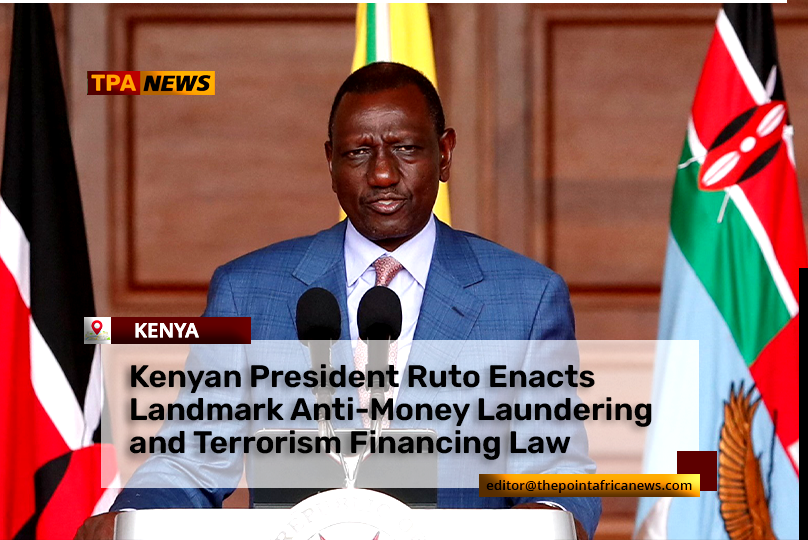

NAIROBI, Kenya – Kenyan President William Ruto on Tuesday, June 17, 2025, signed into law the Anti-Money Laundering and Combating of Terrorism Financing Laws (Amendment) Bill, 2025, marking a significant step in the nation’s efforts to strengthen its framework against financial crimes.

According to a statement released by the presidency in Nairobi, the comprehensive legislation aims to enhance Kenya’s capabilities in combating money laundering, terrorism financing, and proliferation financing. Its enactment is described as a decisive move to bolster the country’s financial system against illicit financial flows.

The new law introduces amendments to ten existing Acts of Parliament, addressing technical compliance deficiencies previously identified by international bodies such as the Eastern and Southern Africa Anti-Money Laundering Group (ESAAMLG) and the Financial Action Task Force (FATF). Kenya’s inclusion on the FATF “grey list” due to these deficiencies had prompted an urgent need for legal reform to restore investor confidence and bolster the country’s global financial credibility.
Advertisement

Reach 2M+ pan-African readers

Advertise with us →

Key changes introduced by the legislation include sealing loopholes that have enabled the misuse of property transactions and shell companies for illegal financial activities. It is also expected to introduce enhanced regulatory clarity and oversight in critical sectors such as real estate and mining.

The bill, initially passed by the National Assembly on April 16, 2025, was returned by President Ruto with reservations. It was subsequently passed a second time by the National Assembly on June 3, 2025, with amendments that fully addressed the President’s concerns, paving the way for its final assent.

Author

Written by

Staff writer at The Point Africa News.

Related Stories

78-Hour Legislative Ultimatum: House Intervenes as Monrovia Port Gridlock Strangles Liberian Supply Chains
Business

78-Hour Legislative Ultimatum: House Intervenes as Monrovia Port Gridlock Strangles Liberian Supply Chains

MONROVIA, Liberia — The House of Representatives has stepped directly into Liberia’s maritime logistics crisis, constituting a Joint Committee on Good Governance and Maritime Affairs and imposing a strict 78-hour deadline to dismantle severe cargo congestion at the Freeport of Monrovia.

David S. Johnson•21h ago

Ghana Champions Inclusion of Caribbean Nations in AfCFTA Architecture
Business

Ghana Champions Inclusion of Caribbean Nations in AfCFTA Architecture

ACCRA, Ghana — In a move aimed at translating historical transcontinental ties into formal commercial structures, Ghana has formally proposed extending the trade and investment framework of the African Continental Free Trade Area (AfCFTA) to include the Caribbean Community (CARICOM).

David S. Johnson•23h ago

Morocco Halts African Tomato Shipments as Domestic Inflation Mounts
Business

Morocco Halts African Tomato Shipments as Domestic Inflation Mounts

RABAT, Morocco — The Moroccan government has temporarily suspended export permits for fresh tomatoes bound for sub-Saharan African markets, prioritizing domestic supply stabilization as retail prices approach record highs of 12 to 15 dirhams ($1.20–$1.50) per kilogram in local markets.

David S. Johnson•23h ago

OECD Warns Africa’s Shallow Corporate Debt Markets Constrain Private Sector Expansion
Business

OECD Warns Africa’s Shallow Corporate Debt Markets Constrain Private Sector Expansion

PARIS, France — Africa’s corporate debt markets remain structurally undersized and ill-equipped to supply the long-term capital required for continental economic growth, according to the OECD’s Africa Capital Markets Report 2026 released on Friday. Outstanding market-based corporate debt across all 54 African economies reached just $211 billion at the end of 2025—representing a mere 0.3 percent of global corporate debt despite the continent accounting for nearly 2.7 percent of global GDP.

David S. Johnson•23h ago

Enjoying our journalism?

Get the biggest African stories in your inbox every morning.

By subscribing you agree to our privacy policy. Unsubscribe anytime.