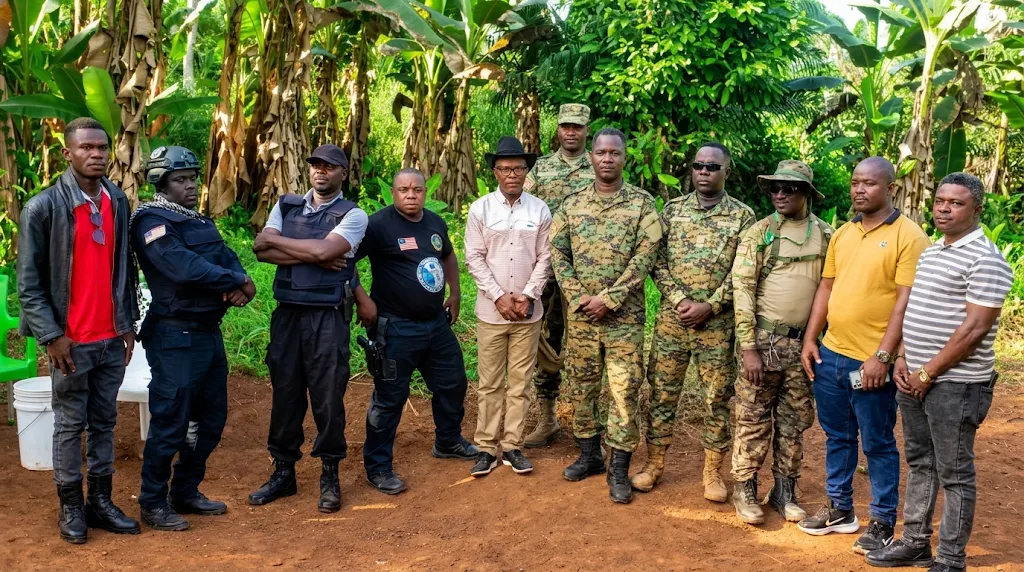
Following an emergency town-hall consultation with local authorities and residents, FDA Deputy Director General for Administration and Finance, Victor W. Kpaiseh, formally categorized the reported occupation of community forestland by Burkinabe nationals as a direct national security threat. The security deployment follows escalating reports of unauthorized forest clearing, agricultural squatting, and physical restrictions imposed on indigenous Liberian farmers attempting to access their ancestral farmlands.
The crisis in Malay Town exposes a volatile intersection of undocumented cross-border migration, informal land tenure contracts, historical boundary disputes, and state regulatory deficits in rural Liberia. The influx of Burkinabe nationals into the dense forest belts of Nimba and Grand Gedeh counties is not a new phenomenon, but its recent expansion into community forest reserves marks a dangerous escalation. Driven by soil degradation, climate pressure, and political turmoil in the Sahel, thousands of agricultural laborers from Burkina Faso have migrated across Côte d'Ivoire into eastern Liberia’s fertile forest zones over the past decade. In many rural communities, local Liberian landholders enter into informal "sixty-forty" sharecropping agreements with foreign farmhands. Under these unwritten arrangements, Burkinabe farmers clear primary rainforest to establish high-yield cocoa and coffee plantations, agreeing to split the mature farms or harvests with the landholder. However, these informal contracts frequently bypass statutory law and local governance structures. As cocoa trees mature, foreign farming enclaves grow into semi-permanent settlements, complete with internal leadership structures. When local Liberians attempt to reclaim or inspect the land, friction erupts over boundary lines, ownership claims, and land access—turning private agricultural arrangements into community-wide territorial disputes. The confrontation in Malay Town highlights severe institutional friction between rural communities and local forestry management bodies. During the FDA mission, residents accused the local Community Forest Management Body (CFMB) of failing to establish clear operational perimeters between Kpablee District and Boe and Quella District, alleging that local elites secretly facilitated the entry of foreign farmers for personal gain. While Samuel Dweh, Chairman of the Boe and Quella Executive Committee, denied encouraging foreign encroachment and maintained that district lines were established in coordination with national authorities, residents insist the underlying boundary ambiguity dates back to unverified administrative surveys from 1952. This decades-old mapping vacuum creates an ideal environment for land grabbing. Without clear, digitized GIS demarcation of community forests, local leaders and external agricultural migrants exploit boundary gaps, clearing protected timber reserves and customary lands without state oversight. The deployment of four forest rangers and three LNP officers underscores the acute enforcement deficit facing the Liberian state in its hinterlands. Expecting seven armed personnel to secure sprawling, dense forest corridors against armed land-clearing crews and unregistered settlements highlights the fragility of national security infrastructure along the Ivorian border. Recognizing the intelligence gap, Deputy Director General Kpaiseh announced that the Liberia Immigration Service (LIS) has been tasked with executing an emergency headcount and enumeration exercise across affected Nimba communities. The audit aims to verify the legal status, nationality, and settlement footprint of foreign populations operating within the forest. Concurrently, the FDA plans to deploy aerial drone technology to re-demarcate the disputed 1952 district boundary lines and identify illegal canopy clearing from the air. The Malay Town crisis represents a direct challenge to the National Forestry Reform Law of 2006 and the Community Rights Law of 2009. If informal sharecropping arrangements are allowed to override statutory community forest protections, Liberia risks losing critical primary rainforest reserves to unregulated commercial cocoa farming. Furthermore, the unchecked growth of armed or isolated foreign agricultural enclaves along porous international borders presents severe geopolitical vulnerabilities. In a region historically prone to cross-border mercenary activity and insurgent movement, the state's inability to monitor who resides in its border forests poses a long-term risk to national stability.