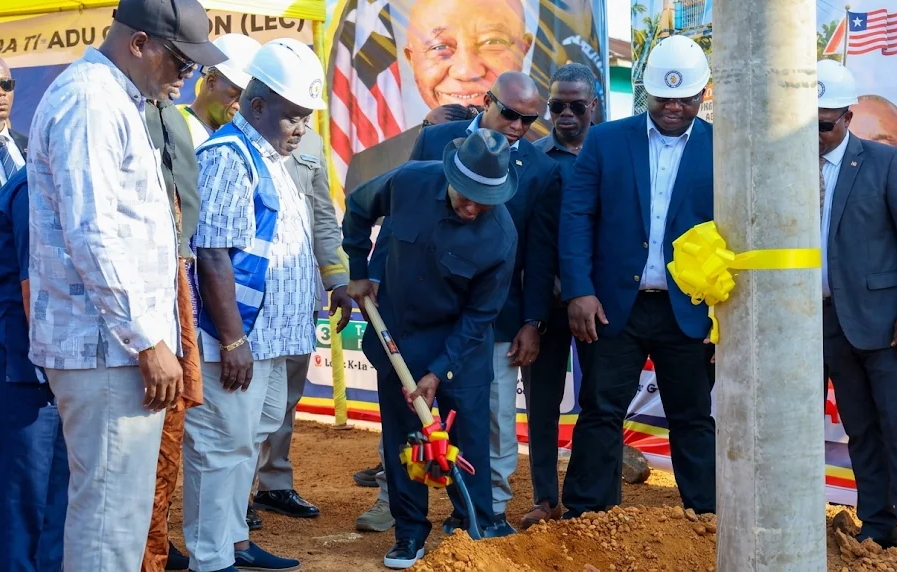
Standing at the Commissioner’s Compound in Clay, the administration framed the expansion as a key milestone of the ARREST Agenda designed to dismantle the historical concentration of state infrastructure within Montserrado County.
The infrastructure build-out aims to extend 101 kilometers of 33-kilovolt overhead distribution lines and 86 kilometers of secondary networks across 18 towns, running from Tubmanburg to Bopolu City, alongside a spur connecting Sawmill to Lofa Bridge and extending grid access to the industrial mining hub of Kinjor. Upon completion, the Liberia Electricity Corporation (LEC) estimates the project will bring formal utility service to 7,033 households, schools, and health posts, serving approximately 35,165 residents.
While the executive rollout signals progress toward the national target of 75 percent electricity access by 2030 under the Mission 300 Compact, an analysis of the project's financial and operational mechanics reveals significant institutional risks, commercial hurdles, and execution challenges.
The most striking feature of the Western Liberia grid extension is its balance-sheet structure. According to LEC Managing Director Mohammed Sherif, the entire multi-county build-out is being funded directly out of the utility's internal operational revenues, executed across 14 project lots by 12 indigenous Liberian contractors.
Committing internal capital expenditure to long-line rural distribution represents a major strategic shift for a state-owned enterprise historically reliant on donor grant funding from the World Bank, the African Development Bank, and the Millennium Challenge Corporation. However, self-financing rural grid extensions puts immense pressure on LEC’s financial health:
Rural line extensions across Bomi and Gbarpolu carry high capital costs per connection due to wide spatial dispersion. Unlike urban Montserrado, where customer density allows for faster capital recovery, rural residential connections yield low average revenue per user (ARPU), prolonging the payback period for LEC's internal capital investments.
Dividing 187 total kilometers of primary and secondary lines among 12 local contractors is designed to build domestic engineering capacity. Yet, it introduces operational fragmentation. Past public works projects in rural Liberia have suffered from uneven execution speeds, variable material standards, and supply chain bottlenecks, raising questions about whether local firms can hit hard completion deadlines without cost overruns.
President Boakai explicitly warned residents during his address that "electricity is not free anywhere," emphasizing that revenue collection, rights-of-way protection, and strict anti-vandalism enforcement are mandatory to sustain grid operations. This emphasis addresses the severe commercial friction currently undermining Liberia’s energy sector. Historically, technical and commercial losses—primarily driven by power theft, illegal tapping, and meter tampering—have consumed up to 40 to 50 percent of total power generated on the LEC grid. Extending lines into remote, under-policed corridors stretching from Sawmill to Lofa Bridge creates significant security vulnerabilities:
Monitoring 187 kilometers of distribution infrastructure against cable theft and illegal hookups requires sustained local policing and community oversight. In counties where security agencies operate on tight fuel and vehicle budgets, preventing illegal connections along isolated corridors will remain a persistent challenge.
While connecting 7,033 households expands formal access, setting tariffs at levels that cover LEC's generation and line-maintenance costs without triggering non-payment or illegal bypasses requires careful balancing. In agrarian regions with low median incomes, high tariff rates frequently push consumers away from formal metering back into informal line-tapping.
The strategic decision to run distribution lines to Kinjor in Grand Cape Mount County introduces an important industrial anchor into the project's economic model. As a major gold-mining district dominated by industrial operations, connecting Kinjor to the national grid allows LEC to capture high-volume commercial off-takers capable of cross-subsidizing low-income residential consumption across surrounding villages.
However, relying on industrial off-takers requires high grid reliability. If line failures, voltage fluctuations, or generation shortages force commercial operators back onto private heavy fuel oil (HFO) generators, LEC risks losing the exact high-margin customers needed to make the Western Liberia grid expansion financially viable.
The Clay groundbreaking demonstrates that the Boakai administration is willing to deploy state utility capital to fulfill political promises of regional equity. But building transmission towers and stringing distribution lines is only the first phase of public utility management.
Without rigorous legislative oversight from the Senate Committee on Energy, strict monitoring by the Liberia Electricity Regulatory Authority (LERA), and robust commercial revenue protection systems along rural corridors, the $35,165-person grid expansion risks adding long-term operational liabilities to an already fragile national power utility. The ultimate measure of the project will not be the ground broken in Clay, but whether reliable, paid power flows through Bopolu, Kinjor, and Lofa Bridge without draining the state utility's core balance sheet.