Executed through the President’s Delivery Unit (PDU) and funded entirely out of central revenues from November 2026 through January 2027, the US$100-a-month stipend program targets 1,250 young people—over half of them young women—across 14 cities and townships, including Gbarnga, Totota, and major urban hubs in Montserrado, Nimba, and Grand Bassa.
While the administration frames the initiative as a dual win for youth empowerment and urban hygiene under the ARREST Agenda, a policy audit reveals significant structural limitations, fiscal vulnerabilities, and execution gaps. Injecting slightly over US$100 monthly directly into the hands of 1,250 participants provides immediate, temporary relief in secondary cities like Gbarnga and Totota, where formal wage employment for youth remains virtually non-existent. However, structured as a 90-day temporary scheme, the program functions as a stopgap public works intervention rather than a sustainable workforce development pipeline. Without linking these young workers to accredited vocational training, waste-to-energy enterprises, or formal municipal employment, the program risks leaving participants back in economic limbo once the three-month cycle concludes in January.
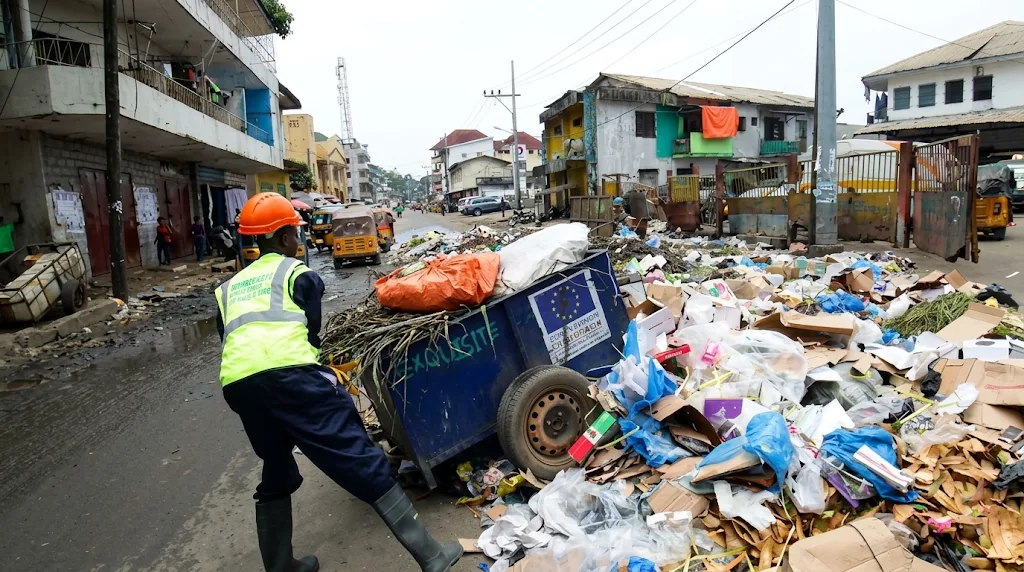
Distributing protective gear, manual cleaning tools, and trash tricycles through 30 community-based organizations addresses visible surface litter, but it fails to address Liberia’s deeper structural sanitation failures. Urban centers across Montserrado, Margibi, and Grand Bassa lack engineered landfills, intermediate transfer stations, and mechanized collection fleets. Handing out brooms and tricycles without establishing secondary waste sorting, recycling plants, or structured municipal fee-collection systems ensures that collected trash simply shifts from residential streets to informal, illegal dump sites, compounding long-term environmental hazards.
Funding the initiative entirely from central government coffers—and placing direct oversight under the Ministry of State’s Monitoring and Evaluation Unit alongside the PDU—bypasses local municipal governance structures. Municipalities like the Monrovia City Corporation (MCC) and regional city councils remain chronically underfunded and dependent on political hand-outs. Rather than building the fiscal and administrative capacity of local city halls to manage municipal services independently, the administration continues to rely on centralized, executive-led discretionary programs that compete for space in an already tight draft FY2027 National Budget.
Deputy Minister Jones noted that extending the initiative beyond its initial three-month footprint remains subject to "available budgetary resources." Coming at a time when the executive is lobbying the 55th Legislature to approve a record $1.538 billion draft budget heavy on recurrent payroll liabilities and debt servicing, funding ad-hoc public works projects beyond January will face fierce legislative scrutiny. Without dedicated statutory funding streams built directly into municipal transfers, the Clean City Initiative risks joining a long list of past presidential cleanup campaigns that dissolved as soon as the initial discretionary funds ran out.