
By: TPA News Desk | Local Stories | www.thepointafricanews.com/africa/local-stories
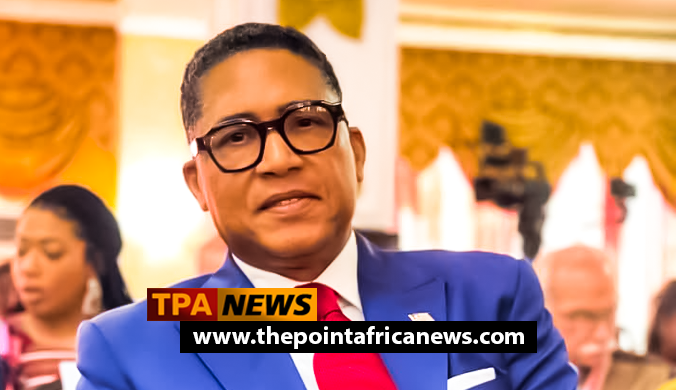
As Liberia marked its 178th Independence Day at the Centennial Memorial Pavilion, the nation paused to reflect on its past and chart a course for its future under the poignant theme, “One People, One Destiny: Healing the Past, Building the Future.” The keynote address, delivered by Emmett L. Dunn, Presidential Special Envoy for Partnership & Philanthropy at the Ministry of Foreign Affairs, resonated with a blend of personal humility, historical reckoning, and a fervent call to collective action.
In a morning gathering attended by President Joseph Nyuma Boakai, Sr., First Lady Kartumu Boakai, Vice President Jeremiah Kpan Koung, distinguished heads of government, legislative leaders including Speaker Richard Koon and President Pro Tempore Nyonblee Karnga-Lawrence, Chief Justice Designate Sie-A-Nyene Yuoh, Foreign Minister Sara Beysolow Nyanti, and members of the diplomatic corps, Dunn acknowledged the profound honor of serving as National Orator. He shared a personal narrative of humble beginnings, recalling selling his mother’s bread in Joe Bar Market. “Those early mornings, dusty feet, and long days taught me dignity, perseverance, and service,” Dunn stated, emphasizing that his presence on such a sacred platform was a testament to divine grace, family strength, and “the enduring possibility of Liberia.”
Dunn’s address moved beyond mere commemoration, framing the 178th anniversary as a “summons” to confront Liberia’s complex history with honesty. He acknowledged the nation’s founding on high ideals of liberty and self-governance, yet bravely confronted the “painful” reality of deep divides between settlers and indigenous populations, leading to decades of marginalization where many felt “strangers in their own land.” The orator somberly recounted the instability following the 1980 military coup and the devastating civil war that claimed over 250,000 lives, displaced nearly a million, and shattered institutions and trust. Despite these grave trials—economic collapses, dictatorship, and disease—Dunn declared, “Liberia has never surrendered. Time and time again, our nation has bent but never broken.” He celebrated Liberian resilience, exemplified by the farmer in Foya, the teacher in Ganta, the nurse in Pleebo, the market woman in Paynesville, and the young man in Buchanan, all fighting “against extraordinary odds” to build the nation.
The address then pivoted to commend President Boakai’s administration, particularly for Liberia’s historic election to the United Nations Security Council, hailing it as a testament to the President’s “steady leadership” and commitment to positioning Liberia as a “responsible and respected voice on the global stage.” Dunn also lauded the strides made in fulfilling the promises of the ARREST Agenda for National Development. He highlighted progress in anti-corruption and governance, citing the strengthening of the Liberia Anti-Corruption Commission (LACC) and a recent Memorandum of Understanding between the Financial Intelligence Agency and the LACC for unified oversight. On infrastructure, Dunn noted renewed momentum in road rehabilitation, specifically mentioning improvements from Monrovia to Zwedru, and praised the improved performance of the Liberian Electricity Corporation. In education, he pointed to increased budget allocations, teacher training, distribution of learning materials, and new investments in early childhood education. Health and social services have seen growing access to rural clinics, international partnerships, and stronger support for healthcare workers, with a commendable emphasis on maternal health. Agricultural revitalization was underscored by efforts to elevate food security and empower local farmers, promoting the vision that “Liberia must feed itself.” The procurement of fire trucks and the purchase of buses for the National Transportation System were also cited as tangible actions.
However, Dunn did not shy away from acknowledging persistent challenges. He stated that corruption remains “deeply embedded” and requires “moral courage and political will” from all branches of government. High unemployment, widening economic inequality where “too many of our people go to bed hungry,” and systemic gender inequality were also highlighted. He stressed the fragility of the education system, noting that “too many children still sit on floors” and schools lack trained teachers, urging a push for “transformation” over mere improvement. The orator also raised alarm about drug abuse “silently destroying the future of Liberia’s youth,” labeling it both a health epidemic and a national security risk.
Emmett Dunn then urged Liberians to embark on a journey of healing the past. He acknowledged “wounds… left untreated” from tribalism, exclusion, economic injustice, and political and gender violence. He praised President Boakai’s “bold actions,” including the recent reburial of former President Samuel K. Doe and the Memorial Service for former President William R. Tolbert, Jr., as well as the President’s apology to the Liberian people on July 5, 2025, for past atrocities, which Dunn accepted on behalf of the populace. To build on this, he proposed the establishment of a standing National Commission on Reconciliation—a “nonpartisan and inclusive” body tasked with continuing national healing through historical truth-telling, civic education, and programs promoting social cohesion.