
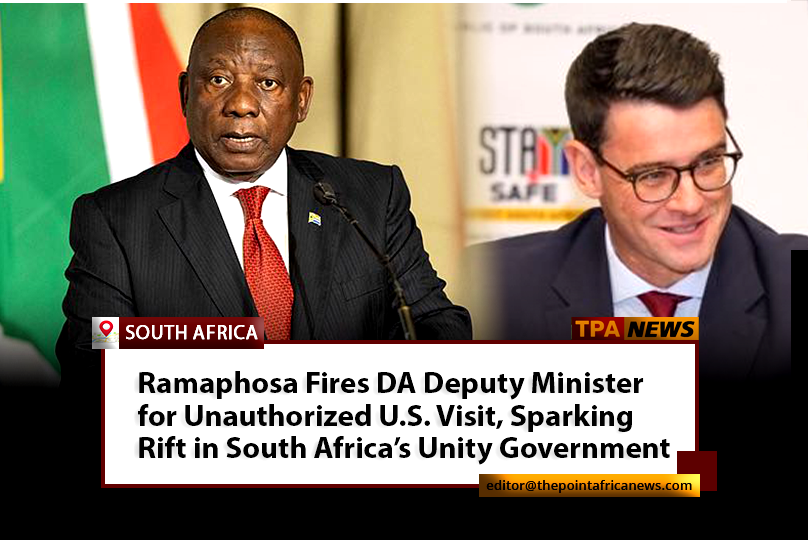
South African President Cyril Ramaphosa has dismissed Deputy Minister of Trade, Industry and Competition, Andrew Whitfield, over an unauthorized trip to the United States—an action that has deepened political friction within the country’s fragile Government of National Unity.
Ramaphosa confirmed the decision on Friday, citing a breach of executive protocols that require all cabinet members and deputy ministers to obtain presidential approval before engaging in international travel. According to the Presidency, Whitfield embarked on the U.S. trip in March 2025 despite receiving no formal clearance from President Ramaphosa or the Department of International Relations and Cooperation (DIRCO).
“All international travel by members of the executive must be authorized by the President,” Ramaphosa reiterated in an official statement, referencing precedents set by former Presidents Nelson Mandela and Thabo Mbeki, both of whom dismissed officials for similar offenses in 1995 and 2007.
Whitfield, who represents the Democratic Alliance (DA)—South Africa’s leading opposition party and a key coalition partner in the post-2024 unity government—has defended his actions. He confirmed that he submitted a travel request on February 12, received no response, and later sent an apology letter. Despite the lack of formal approval, he proceeded with the U.S. visit, which reportedly involved meetings with trade policy experts and private investors.
Speaking publicly for the first time since his dismissal, Whitfield said he was disappointed with the president’s decision and argued that no justification had been formally communicated to him. He added that he acted in the national interest and believed the urgency of the engagement warranted his presence.
The DA has reacted sharply, with party leader John Steenhuisen accusing Ramaphosa of political double standards. In a press briefing Friday afternoon, Steenhuisen labeled the dismissal a “calculated assault” on the coalition agreement and issued a 48-hour ultimatum demanding that Ramaphosa take similar action against ANC cabinet members implicated in corruption and maladministration.
“It cannot be that an opposition deputy minister is fired over a paperwork delay, while ministers facing state capture allegations remain untouched,” Steenhuisen said.
The DA is expected to nominate a replacement for Whitfield, as requested by Ramaphosa, but party insiders have suggested that the removal could trigger a broader renegotiation of the coalition agreement—especially with tensions already simmering over budget allocations and policy implementation across ministries.
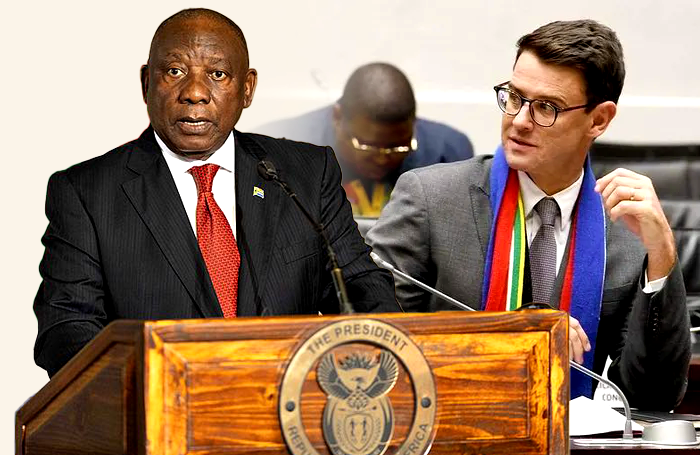
Political observers say the incident is a clear signal from Ramaphosa that he intends to enforce discipline in a multi-party cabinet where rival agendas often clash.