
By: TPA News Desk | editor@thepointafricanews.com | OPINION
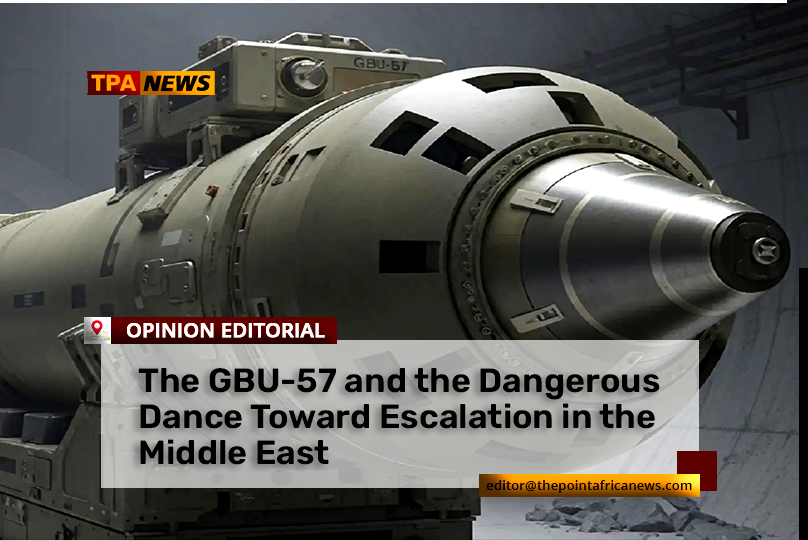
The ongoing tension between Iran and Israel has once again escalated into a crisis that risks pulling the entire region—and possibly the world—into conflict. At the center of the current alarm is not just rhetoric or even rocket fire, but a single bomb: the American-made GBU-57, also known as the Massive Ordnance Penetrator (MOP).
Weighing nearly 14,000 kilograms and capable of burrowing 60 meters into the earth before detonation, the GBU-57 is not just a piece of military hardware. It is a symbol of technological dominance, a signal of potential intervention, and, more dangerously, a trigger that could ignite a full-blown war in the Middle East.
Iran has long been suspected of hiding elements of its nuclear program beneath mountains and reinforced bunkers, most notably at Fordow. Israel, citing existential threats, has repeatedly targeted Iran’s nuclear infrastructure. But it lacks the capability to penetrate such hardened sites. That’s where the United States comes in—wielding the one weapon that could reach these subterranean targets.
The presence of the GBU-57 in any nearby U.S. airbase, or its transfer to Israeli hands, changes the dynamics of deterrence and diplomacy. It signals not just a readiness to act, but a refusal to allow Iran any ambiguity. In a time when words still matter, the deployment of such a bomb speaks volumes—and shouts over any calls for dialogue.
But what are the consequences? Iran, already on high alert, has interpreted the signal clearly: if that bomb is used, America is no longer a silent partner, but a full combatant. The ripple effect of that decision would stretch from Baghdad to Beirut, from the Red Sea to the Mediterranean. A regional conflict would become a global one—dragging in allies, destabilizing oil markets, and overwhelming diplomacy.