
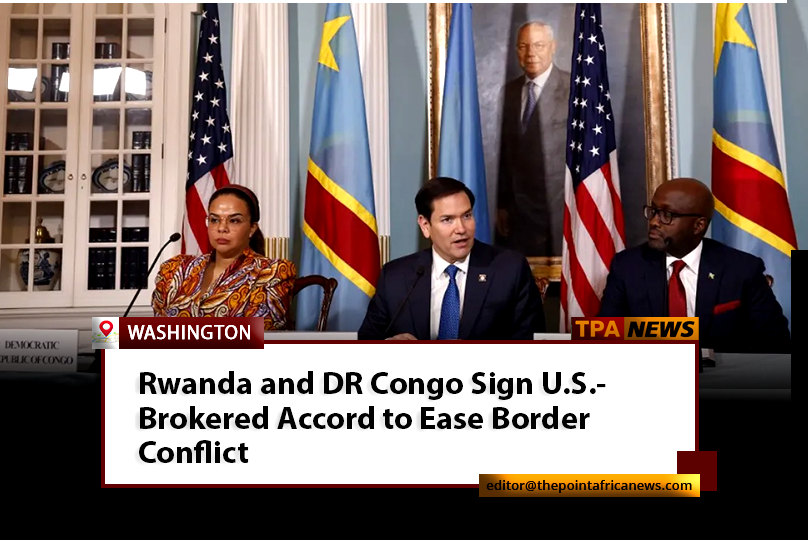
The Democratic Republic of Congo (DRC) and Rwanda signed a peace agreement in Washington, D.C., on Friday, marking what many hope is a turning point in decades of tension and conflict between the two Great Lakes neighbors. The U.S.-brokered accord, witnessed by international diplomats and hosted by U.S. Secretary of State Marco Rubio, commits both nations to immediate de-escalatory steps aimed at ending ongoing hostilities in eastern Congo.
The agreement commits Rwanda to halting its “defensive measures” inside Congolese territory—language widely understood to refer to Kigali’s military presence and reported support for rebel groups such as M23. In return, Kinshasa has pledged to cease all forms of direct or indirect support to Hutu armed militias operating in its volatile eastern provinces, particularly the Democratic Forces for the Liberation of Rwanda (FDLR), a group made up in part of individuals accused of participating in the 1994 Rwandan genocide.
Rwanda’s Foreign Minister, Olivier Nduhungirehe, confirmed the deal shortly after the signing ceremony, stating that the DRC had agreed to halt all backing of the FDLR and affiliated factions. In exchange, he said, Rwanda would begin phasing out its controversial cross-border security operations, which have fueled sharp regional criticism and accusations of aggression.
While officials did not release the full text of the agreement, sources close to the talks said the deal also includes plans for joint monitoring and intelligence-sharing, as well as the formation of a regional oversight committee to track implementation. The parties are expected to report progress in phases, with neutral observers monitoring troop movement and militia disarmament in affected areas.
The peace deal comes after months of renewed violence in eastern Congo, where M23 rebels—believed to be backed by Rwanda—have taken control of key territories, including areas near Goma and Bukavu. Meanwhile, the FDLR and other local militias have continued to destabilize the region, attacking civilians and further straining relations between Kinshasa and Kigali.
Both the United Nations and African Union have warned in recent months that continued hostilities risk plunging the region back into full-scale war. The U.S., alongside Qatari diplomats, played a key mediating role in pushing the two parties toward negotiation.
Still, the agreement is not without its critics. Human rights groups and political analysts have warned that the deal does not address the role of M23 directly, nor does it contain clear enforcement mechanisms. Without firm accountability measures or third-party verification on the ground, many fear that both governments could fall back into old patterns of blame and covert military support.