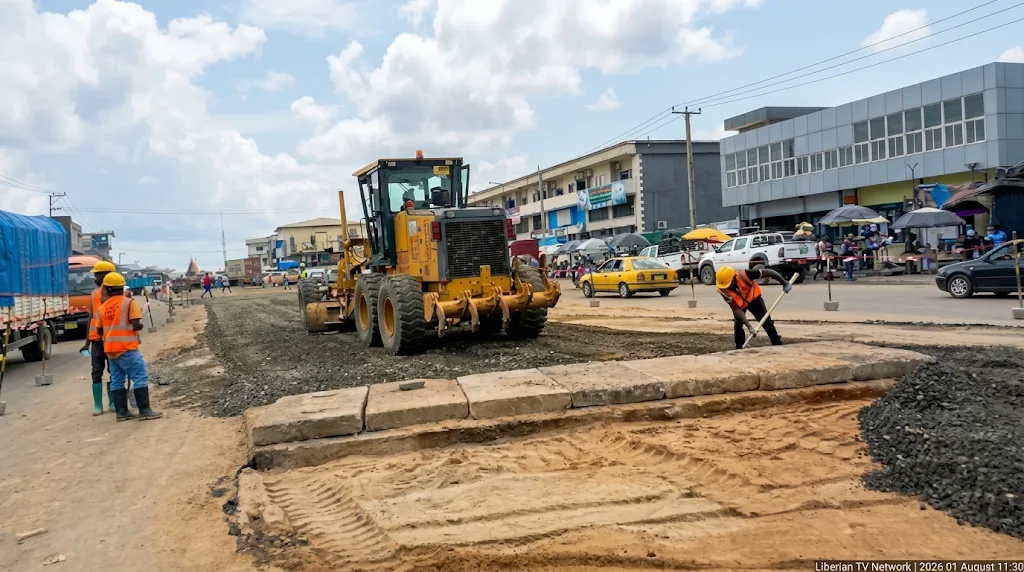
An analysis of Ministry of Public Works expenditure figures in the draft budget shows substantial disbursements for city streets and community road projects by September 30, 2026. Among the examples are US$950,000 for Kakata City Streets, US$1.19 million for Gbarnga City Pavement, US$1.62 million for Buchanan City Streets, US$1.39 million for Barclayville and approximately US$1.33 million for Bopolu. Ganta Streets also received its full US$300,000 allocation.
These figures deserve public attention, particularly where communities have yet to see the expected construction. But a disbursement is not, on its own, proof of completed work—or evidence that funds have been misappropriated. It records a financial movement, not necessarily the physical progress of a road project.
There is also an important distinction in the government's own account. In a November 3 briefing, Public Works Minister Roland Layfette Giddings said the ministry had 14 ongoing city-street and urban road projects, with work already underway in places including Kakata and Foya. The ministry reported that some sections had been paved, while other projects were substantially completed or approaching their final paving stages. It also said a new group of county-city projects was scheduled to commence during the dry season, with several expected to start in November and others in December.
This means the assertion that no streets have been paved is too sweeping. The more precise question is whether the projects receiving the reported 2026 disbursements have delivered physical progress proportionate to the money released.
The budget figures nevertheless expose accountability gaps that deserve answers. For each project, the Ministry of Public Works and the Ministry of Finance should disclose the contractor, contract value, amount paid, date of payment, mobilization status, percentage of work completed and expected completion date. Where advances have been released, the government should explain what safeguards are in place to ensure that contractors deliver the agreed work.
The issue also has implications for the government's development agenda. The draft FY2027 budget proposes US$7 million for construction and rehabilitation of city streets under the County Development Agenda. That allocation will be difficult to defend as a meaningful development investment if existing projects cannot demonstrate transparent financial and physical progress.
Residents in county capitals are not asking merely for budget allocations or announcements of future construction. They want roads that can be used, reliable drainage, safer communities and visible improvements in their daily lives.
The Legislature should therefore go beyond reviewing the amounts allocated and disbursed. It should demand project-by-project evidence of what has been delivered, what remains outstanding and why. The General Auditing Commission should also be able to examine whether payments correspond to verified work and contractual obligations.
Liberia does not simply need more money allocated to roads. It needs a public investment system that can demonstrate, clearly and independently, what every major disbursement has achieved. A road project should not be measured by how much money has been released, but by what has actually been built.
Beyond the Headlines, this is the Bigger Picture.