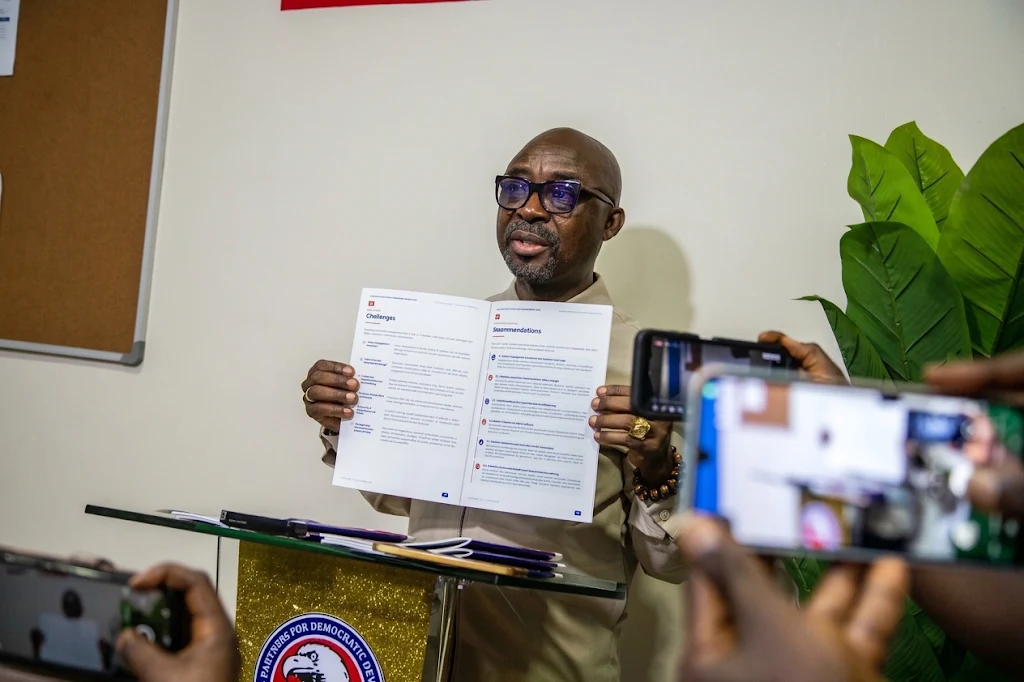
A new monitoring report by NAYMOTE Partners for Democratic Development offers an important perspective on that question, revealing a gap between constituency engagement and formal accountability among members of Liberia's House of Representatives.
The organization's Second Legislative Constituency Monitoring Report 2026 assessed the activities of lawmakers during the second constituency break, covering the period July 17 to October 9, 2026. The exercise monitored 72 of Liberia's 73 electoral districts across all 15 counties, representing approximately 98.6 percent coverage.
The findings present a mixed picture of legislative engagement, with a relatively high number of Representatives recording constituency visits, but considerably fewer demonstrating formal reporting and institutional mechanisms for maintaining accountability to their constituents.
Of the 72 Representatives monitored, 66, representing 91.7 percent, reportedly visited their constituencies during the assessment period. Fifty-six, or 77.8 percent, conducted townhall meetings or public consultations, while 51, representing 70.8 percent, engaged constituents through radio or other media platforms.
However, the figures declined when the assessment examined institutional accessibility and formal reporting. Only 45 Representatives, representing 62.5 percent, had functional district offices, while just 36, or 50 percent, had provided formal legislative reports or updates to their constituents.
These findings raise a broader question about the nature of political representation in Liberia: Is physical presence in a constituency translating into meaningful public accountability?
Constituency visits are an important component of representative democracy. They provide lawmakers with opportunities to understand local conditions, consult citizens and identify issues requiring legislative attention or government intervention.
However, physical presence alone does not establish the extent to which a Representative is fulfilling the broader responsibilities of the office. Citizens also need to know what their lawmakers are doing in the Legislature, which policies and bills they support, how they participate in committee proceedings, what oversight activities they undertake and whether concerns raised in their districts are being pursued through appropriate institutional channels.
This is where NAYMOTE's findings become particularly significant. Although 66 Representatives reportedly visited their constituencies, only 36 had documented formal legislative reports or updates. This leaves a difference of 30 lawmakers, representing 41.7 percentage points of the monitored group.
The distinction is important. It does not establish that every Representative without a recorded formal report failed to communicate with constituents. However, it highlights a weakness in the documentation and formal reporting of legislative activities, making it difficult for citizens to obtain a consistent account of their representatives' work.
Democratic accountability requires more than occasional interaction between elected officials and their constituents. It also requires accessible information that allows citizens to assess performance, question decisions and follow up on commitments.
Perhaps one of the more revealing aspects of the assessment is its examination of the nature of constituency engagements. According to NAYMOTE's findings, some constituency activities were dominated by donations, project dedications, community ceremonies, Independence Day and Flag Day celebrations, and political networking, rather than substantive policy discussions and legislative feedback.
While these activities may contribute to community visibility and provide opportunities for interaction between lawmakers and residents, they do not necessarily demonstrate effective legislative representation.
The concern is not that donations, community celebrations or participation in public events have no value. Rather, the question is whether these activities are receiving greater attention than the responsibilities that allow citizens to understand, scrutinize and evaluate their elected representatives. A Representative's responsibility extends beyond attending public gatherings or providing occasional assistance to individuals and communities.
It includes explaining legislative decisions, communicating the status of proposed legislation, reporting on committee assignments, highlighting oversight interventions and demonstrating how issues raised by constituents are being addressed. When constituency engagements are largely measured by public appearances and ceremonial activities, the substance of representation risks becoming secondary to political visibility.
This is a critical distinction that NAYMOTE's monitoring brings into focus: being present in a community is not necessarily the same as being accountable to it.
How Accessible Are Representatives? Another important finding concerns the availability of functional district offices. According to NAYMOTE, 45 of the 72 monitored Representatives had functional offices in their respective electoral districts, leaving 27 without one recorded during the assessment.
District offices can serve as an important link between elected officials and their constituents, providing a recognizable point of contact where citizens can raise concerns, seek information and obtain updates on legislative activities.
Without accessible offices or clearly communicated alternatives, maintaining consistent engagement becomes more difficult, particularly for citizens who cannot travel to Monrovia to reach their representatives.
However, the existence of an office should not automatically be treated as evidence of effective representation. Its accessibility, staffing, operating arrangements and responsiveness to citizens are equally important. The larger issue, therefore, is not simply how many Representatives maintain offices, but whether constituents have reliable and consistent channels through which they can reach their elected officials.
What Are Citizens Saying, and What Happens After the Meetings?
NAYMOTE's monitoring also provides insight into the concerns raised during constituency engagements. Among the issues identified were poor road infrastructure, inadequate healthcare facilities, educational challenges, youth unemployment, economic opportunities and community development.
These concerns reflect some of the longstanding public service and development challenges facing communities across Liberia. Townhall meetings and public consultations provide opportunities for citizens to communicate these priorities directly to their elected representatives. But the effectiveness of such engagements ultimately depends on what happens after the meetings.
Are concerns documented? Are relevant ministries and government institutions contacted? Are issues requiring legislative intervention raised through appropriate channels? Are commitments followed up, and are constituents informed about the progress made?
NAYMOTE identified weaknesses in the organization and documentation of some consultations, including inadequate agendas and insufficient mechanisms for tracking commitments. Its recommendations call for public registers that identify commitments, responsible institutions, deadlines and progress. Such mechanisms could help transform constituency engagements from occasional consultations into more structured processes of public accountability.
While the report provides a useful picture of constituency engagement, its findings must also be understood within the limits of its methodology. NAYMOTE deployed 72 trained monitors across Liberia's 15 counties, supported by interns and its office-based team. The monitoring exercise involved field visits, physical inspections of constituency offices, community engagements, standardized questionnaires and follow-up communications with lawmakers.
The organization also used digital data collection tools, including Google Forms and Open Data Kit (ODK), alongside telephone calls, text messages and WhatsApp communications. Its assessment covered 72 of Liberia's 73 electoral districts. Montserrado County Electoral District 10 was excluded because of a court-related dispute involving its Representative and the House of Representatives.
Nevertheless, the assessment primarily measured whether particular activities were recorded during the monitoring period. It did not comprehensively evaluate the quality of every engagement, the effectiveness of legislative interventions or the extent to which community concerns were resolved.
For example, a Representative who held one townhall meeting and another who organized several could both be recorded as having conducted public consultations.
Similarly, a recorded constituency visit does not necessarily demonstrate that citizens were meaningfully consulted or that their concerns received attention. The findings should therefore be understood as a descriptive assessment of recorded engagement across selected indicators, rather than a comprehensive performance ranking of Liberia's lawmakers.
This distinction is essential to interpreting the findings fairly and avoiding conclusions that go beyond the evidence. The second monitoring exercise also provides an opportunity to examine how constituency engagement is evolving.
In its first 2026 monitoring exercise, which covered 69 electoral districts between March 19 and May 8, NAYMOTE reported that 80 percent of monitored lawmakers visited their constituencies, 64 percent conducted townhall meetings, 46 percent engaged through local radio and 26 percent presented formal reports. In the second exercise, the corresponding figures rose to 91.7 percent, 77.8 percent, 70.8 percent and 50 percent.
The figures indicate higher recorded participation across these four overlapping indicators in the second monitoring period. However, the exercises covered different numbers of districts and separate constituency breaks. The results should not, on their own, be treated as proof of sustained improvement in legislative performance. What they do demonstrate is the continuing importance of monitoring lawmakers' activities and making the findings available to the public.
More importantly, the persistence of weaknesses in formal reporting suggests that greater constituency visibility has not necessarily been accompanied by equally strong reporting practices.
Perhaps the most important issue emerging from the assessment is the extent to which constituency accountability depends on individual initiative rather than consistent institutional requirements.
NAYMOTE is calling for standardized reporting procedures, regular public consultations, accessible district offices and stronger mechanisms for tracking commitments made to constituents. These recommendations point toward a broader institutional question: Should regular reporting and constituency engagement remain largely voluntary practices, or should the Legislature establish common standards that apply to all Representatives?
A more structured accountability framework could require lawmakers to publish constituency engagement schedules, provide periodic reports on legislative activities, document public consultations and communicate progress on issues raised by their constituents. Such measures would not necessarily guarantee better representation, but they would give citizens more consistent information with which to evaluate their elected officials.
The House of Representatives also has an important role in considering whether existing legislative procedures adequately support transparency and communication between lawmakers and the people they represent. The responsibility for improving accountability should not rest solely on individual lawmakers or civil society monitoring organizations. Institutional leadership, legislative procedures and public access to information all have a role in strengthening representative democracy.
The Bigger Picture
The significance of NAYMOTE's findings extends beyond the performance of individual Representatives during a single constituency break. They raise fundamental questions about how representative democracy operates between elections, how citizens obtain information about legislative decisions and whether public concerns raised at the community level are followed through to meaningful institutional action.
The fact that 91.7 percent of monitored Representatives had recorded constituency visits is an important indicator of engagement. But the finding that only half had recorded formal legislative reports illustrates why physical presence and public accountability should not be treated as interchangeable measures.
Ultimately, representation is not measured only by how frequently elected officials return to their constituencies, attend public gatherings or appear on radio programmes. It also involves explaining decisions, making legislative work accessible, following up on public concerns and demonstrating what has been done with the responsibilities entrusted to them.
For Liberia, the challenge is to move beyond measuring the visibility of elected officials toward building a system in which their activities, decisions and commitments are consistently documented and open to public scrutiny. The question citizens should continue asking is not simply whether their Representatives visited their districts, but what those visits achieved, what commitments were made and what evidence exists that those commitments are being pursued.
Because democracy does not end when citizens cast their ballots. It continues through the accountability of those elected to represent them.