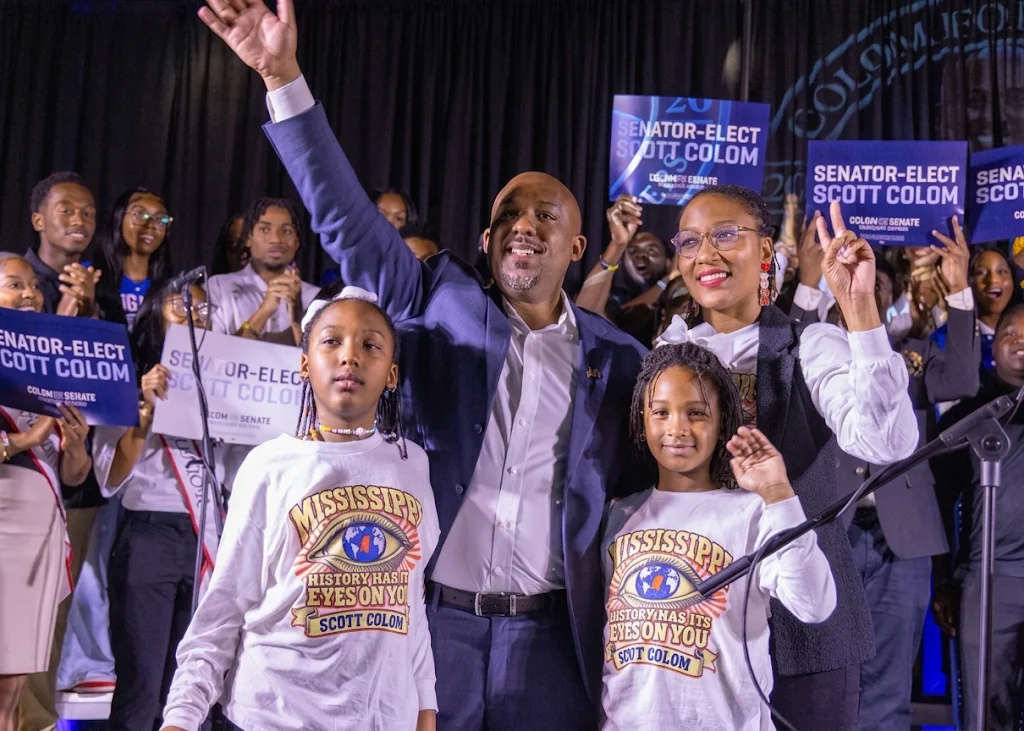
At 43, Colom is set to become Mississippi's first Black U.S. senator since the Reconstruction era following the American Civil War. His election is particularly significant because he is also the first Black candidate from the state to win a Senate seat through a direct vote of the electorate.
But Colom is not the first Black man to represent Mississippi in the Senate. That distinction belongs to two men whose political achievements emerged during one of the most consequential periods in American history.
The story begins in 1870, just five years after the end of the Civil War and during the Reconstruction era, when the United States was attempting to rebuild the former Confederate states and establish political rights for formerly enslaved African Americans.
On February 25, 1870, Hiram Rhodes Revels of Mississippi took the oath of office, becoming the first African American to serve in the United States Senate. A minister, educator and politician, Revels entered the Senate at a time when Black Americans were beginning to exercise political rights that had previously been denied to them under slavery.
His election followed the ratification of the Fifteenth Amendment, which prohibited denying citizens the right to vote on the basis of race, colour or previous condition of servitude. Revels served until March 1871. Five years later, Mississippi produced another historic figure: Blanche K. Bruce, who was elected by the state legislature in 1874 and began his Senate service in 1875.
Bruce had been born into slavery before the Civil War but went on to become a prominent political figure. During his Senate tenure, he became the first African American to preside over the Senate, serving as its presiding officer in 1879.
Bruce left office in 1881. For the next 145 years, no other Black person would represent Mississippi in the United States Senate. The gap between Bruce's departure and Colom's election cannot be understood without examining the political changes that followed Reconstruction.
Although the Civil War ended slavery, the struggle over the political rights of formerly enslaved people continued. During Reconstruction, Black men voted, held public office and participated in state and national government across the South.
However, the period faced intense resistance from white supremacist political groups and opponents of racial equality. In Mississippi, the 1875 elections marked a major turning point. White Democrats used intimidation, violence and political manoeuvring to regain control of the state government from the Republican coalition that included Black voters and officeholders.
By 1890, the state's political leadership had adopted a new constitution that introduced poll taxes and literacy tests as voting requirements. Although presented as general qualifications, these measures were designed and administered to suppress Black political participation, alongside that of many poor white voters.
The consequences were severe. Black voter registration and participation declined dramatically, helping establish a political system that restricted African Americans' ability to influence elections and hold public office. These restrictions formed part of the wider Jim Crow system of racial segregation and disenfranchisement that shaped the American South for generations.
It was not until the civil rights movement of the 1950s and 1960s that the country made major advances in dismantling these barriers. The Voting Rights Act of 1965 gave the federal government stronger authority to protect citizens against discriminatory voting practices. Yet the restoration of voting rights did not immediately translate into equal political representation.
Colom was born and raised in Mississippi and built his career in law and public service. He studied at Millsaps College before earning his law degree from the University of Wisconsin Law School. His career included service as a prosecutor and later as district attorney for Mississippi's 16th Judicial District, which covers four counties along the Mississippi-Alabama border.
In 2015, he won election as district attorney, becoming the first Black person elected to that position in the district. His professional background also includes a nomination by former President Joe Biden for a federal judgeship, although the nomination did not advance through the Senate confirmation process. Colom's campaign for the Senate focused on economic concerns affecting Mississippi residents, including healthcare access, employment, rising living costs and the challenges facing rural communities.
He also sought to connect with voters beyond the traditional Democratic base, campaigning across all 82 counties in the state. Colom defeated Republican incumbent Cindy Hyde-Smith in the November 2026 midterm election, with the Associated Press projecting him as the winner after several days of counting absentee and provisional ballots.
With 99 percent of the expected vote reported, Colom led with 49.2 percent against Hyde-Smith's 48.7 percent, a margin of approximately 4,700 votes. The narrow result followed a competitive campaign in a state that has traditionally favoured Republican candidates in federal elections. Hyde-Smith, who entered the Senate in 2018 after being appointed to fill a vacancy, conceded the race and congratulated Colom.
During his victory celebration at Tougaloo College, a historically Black institution in Jackson, Colom acknowledged the significance of the moment and connected his achievement to the sacrifices of earlier generations who fought for civil rights and political participation. His victory also marked the first time since 1982 that Mississippi elected a Democrat to the U.S. Senate.
Colom's election carries significance beyond the change in party representation. In 1870, Hiram Revels entered the Senate at a time when the country was emerging from slavery and attempting to establish a new political order. Five years later, Blanche K. Bruce continued that historic presence.
But the end of Reconstruction, the rise of Jim Crow laws and decades of voter suppression effectively closed many of the political opportunities that had briefly opened to Black Americans in the South. Colom's election comes more than a century later, under a different electoral system and after generations of civil rights struggles.
There is also an important distinction between his achievement and those of his predecessors. Revels and Bruce were elected by the Mississippi Legislature during Reconstruction. Colom's victory came directly from voters across the state, making him the first Black Mississippian elected by popular vote to represent the state in the U.S. Senate.
As he prepares to take office in January 2027, Colom will inherit the responsibility of representing a state whose history reflects both the early breakthroughs of Black political participation and the long struggle to secure equal access to the ballot.